Automa – Italy – Monitoraggio e telecontrollo reti oil, gas, water

Ivano Magnifico

By Ivano Magnifico, Product Manager AUTOMA
From the presentation “Back to the future: when the past is already the future”
SMART GRID DAYS 2025, 8 – 9 October 2025.

Are we using the data we receive from the monitoring systems of cathodic protection as we should? To understand this, let’s summarise the history, the current situation and the future of pipeline monitoring, particularly focusing on what we take for granted and what seems normal because we see it every day.

In this article and the previous one, we talk about monitoring methods and how to optimise data transmission, showing you some concrete examples.

With this content, we are mainly addressing foreign readers, who have different management practices than those we have in Italy. However, in any case, the recap can also be useful for us Italians to see if we are working to the best of our abilities.

Remote monitoring for cathodic protection

For a definition of remote monitoring, please click here.

Let’s now see how the information collected can help us carry out our daily business. In order to have effective and efficient cathodic protection, the first thing to do is to check that the devices we use (e.g. power supplies, decoupling devices, mitigation devices, etc.) are working properly. ISO 15589-1 gives us an indication of the devices that must be checked for cathodic protection:

  • Cathodic protection rectifiers
  • Unidirectional drainage station
  • Connections to third-party structures (resistive or direct)
  • AC/DC decoupling devices
  • Galvanic anodes
  • Measurement points

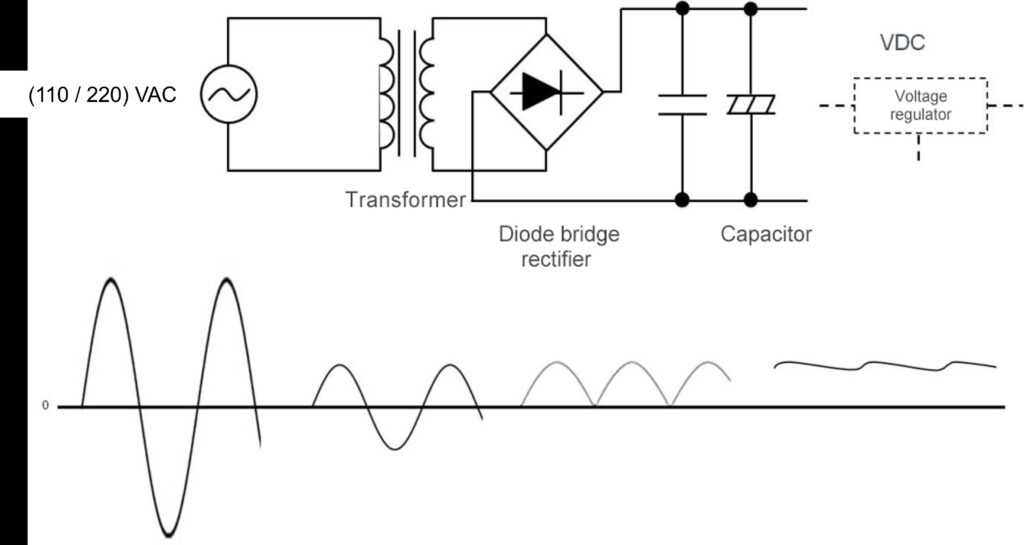
Rectifier: monitoring parameters

Below are theparameters to be monitored in the rectifier to make sure it is working properly.

  • DC output current
  • DC output voltage
    • AC output voltage: alarm if average value > defined threshold
  • Presence/absence of main power supply (real-time alarm)
  • DC potential structure and AC voltage
  • OFF potential on structure
  • Instant-off on coupons to measure IR-free potential
    • DC and AC current density on coupon
Monitoraggio delle condotte gestione protezione catodica alimentatore

When we talk about gas distribution networks within cities, one of the most critical aspects is the life time of the ICCP anode: as long as the ICCP anode is operational, we are able to supply power, but when it wears out, it becomes a problem because it can take up to one or two years to obtain the permits to carry out the work. Therefore, it would be convenient if, in addition to the other information that comes to us, we could also know if and when the ICCP anode is reaching the end of its service life.

Rectifier: assessing the status of the ICCP anode

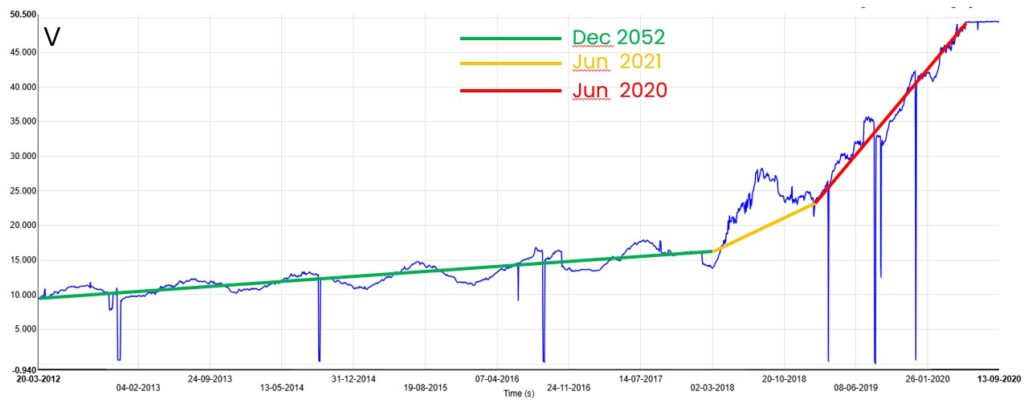
In the graph below, we are not measuring impedance (the ratio between voltage and current) to evaluate the total resistance of the circuit, but we are only measuring the output voltage on a rectifier that has always operated at constant current; therefore, the voltage trend follows the trend of the total impedance seen by the rectifier.

The reference period is 2012-2020. Looking at the graph, we clearly recognise the seasonal trend, i.e. the change in soil resistance between the summer and winter periods. However, it is also possible to detect a certain linearity, which is given by the trend of the volume loss of the ICCP anode over time. As we approach the end of service life, we lose this linear trend that tends to become exponential and this can help us predict even a couple of years in advance the moment when a new ICCP anode will be needed.
Monitoraggio delle condotte gestione protezione catodica alimentatore andamento stagionale

Unidirectional drainage

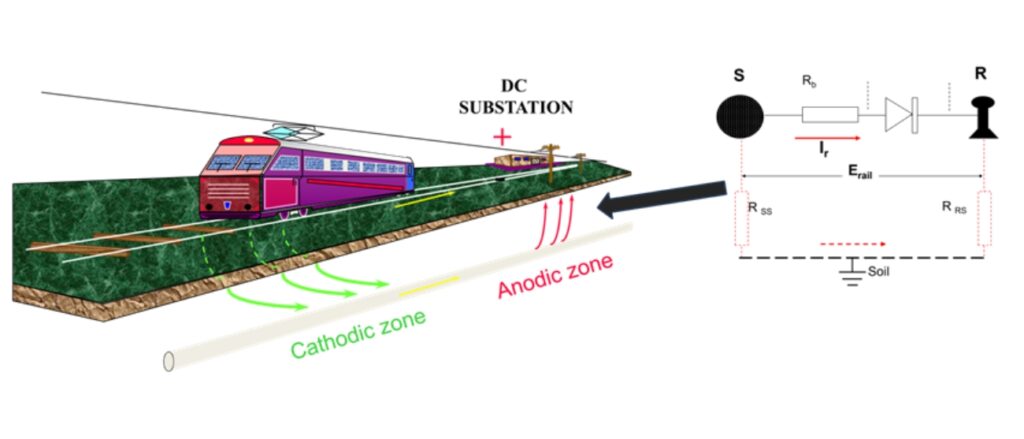
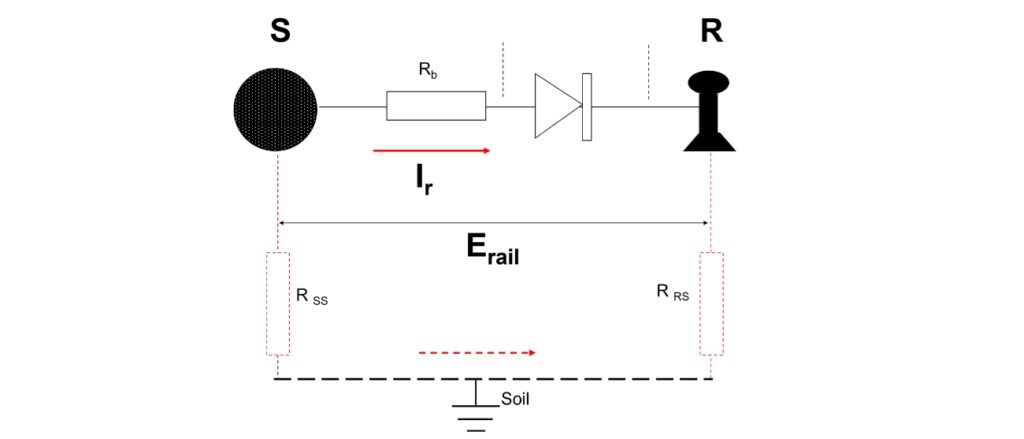
In the vicinity of a railway line, at the point where the interference creates an anode zone of current on our pipe that returns to the original circuit, we will need a drainage, if there are no other ways to solve the problem.
Monitoraggio delle condotte gestione protezione catodica drenaggio unidirezionale

The purpose of drainage is to allow the current, which we absorb in the cathodic area from the railway line, to return via an electrical path to the rail and the substation to which it belongs. Clearly, we only want this current to flow back to the substation and not vice versa.

Another interesting parameter is the potential difference between the structure and the rail: when the structure is more positive than the rail, we expect current to drain, returning to the original circuit; whereas, when the polarisation is reversed, we do not expect current through the diode, because it is reverse polarised.
Monitoraggio delle condotte gestione protezione catodica dreanaggio unidirezionale monitoraggio

The monitoring parameters are:

  • DC drain current
    • Normal condition: Ir ≥ 0
    • Alarm if Ir < 0 (damaged diode)
  • Pipe-to-rail potential (Erail)
    • Normal condition: -V < Erail < 0.7 V + Ir (Rb+Rpr)
      (Rpr = parasitic resistance of the diode)
  • DC potential structure and AC voltage
  • OFF potential on structure
  • Instant-off on coupons to measure IR-free potential
    • DC and AC current density on coupon

Real cases

Unidirectional drainage: diode failure detection

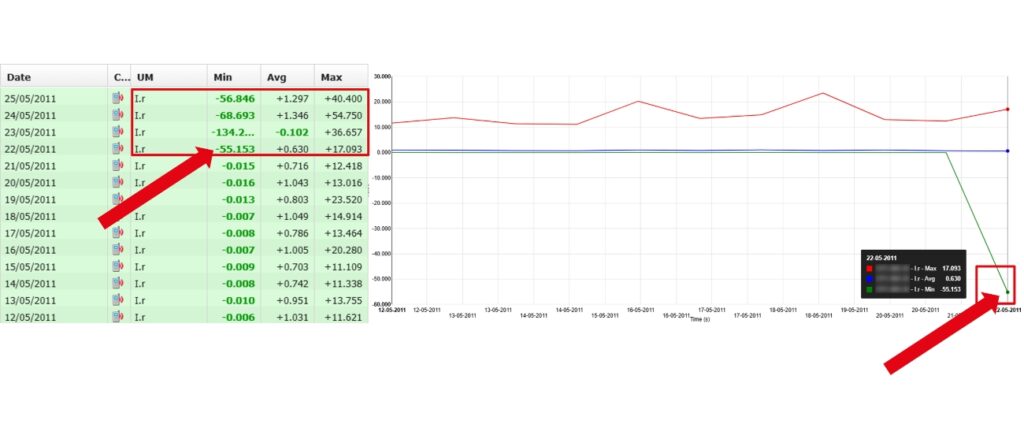
Let’s look at some practical examples. Below you see the diode current trend over a series of days; the current flows in one direction only until 22 May. As shown, after the fault, our pipeline is receiving 55A, 134A, 68A from the rail through an electrical connection: this current, however, must return to its original circuit. Generally, corrosion is not a rapid phenomenon, but in this case it can become so. Therefore, it is essential to receive an alarm so that prompt action can be taken.
Monitoraggio delle condotte gestione protezione catodica dreanaggio unidirezionale guasto diodo

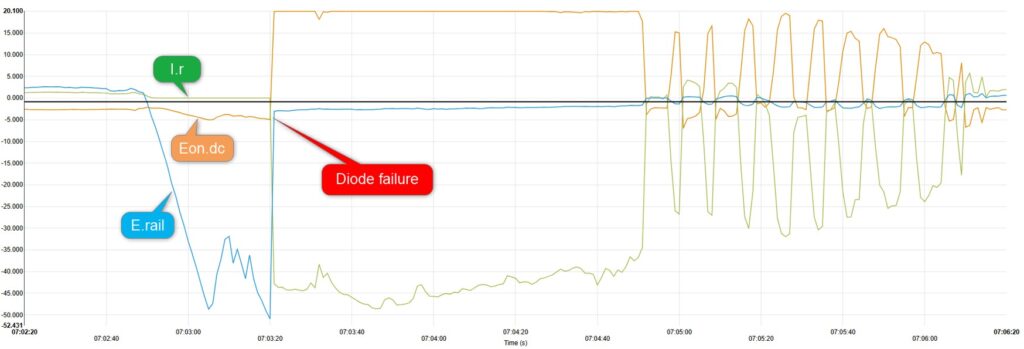
With reference to the Remote Datalogger Unit, it is interesting to point out that we can occasionally ask the device to download the measurement second by second in order to analyse in detail what happened; and that is what we did in this example. We downloaded the intensive measurement per second on the day the diode broke. Below we can see the drained current, the On potential and the tube-rail potential.
Monitoraggio delle condotte gestione protezione catodica remote datalogger unit

AC mitigation device: monitoring parameters

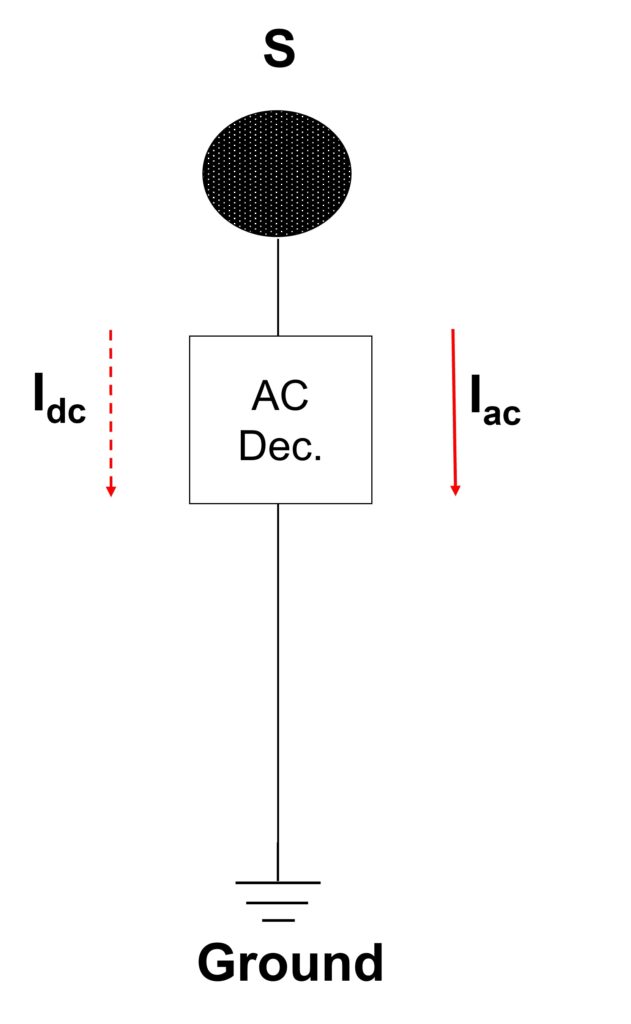
The AC decoupler is a large capacitor between the pipe and the grounding system, which allows the AC current to be discharged to the grounding system while remaining an open circuit for the DC current.
Monitoraggio delle condotte gestione protezione catodica ac mitigation device parameters

What do we monitor?

  • AC current discharged;
  • DC current:
    • Normal condition: average IDC= 0
    • Alarm if average IDC ≠ 0
      (damaged decoupler, presence of resistive path)
  • Grounding potential (Egnd):
    • Alarm if Egnd drops to more negative values;
  • DC potential on structure and AC voltage;
  • OFF potential on structure;
  • Instant-off on coupon to measure IR-free potential;
    • DC and AC current density on coupon.

AC mitigation device: fault detection

The daily report shows the direct current recorded over several days, until the day when the average value becomes different from zero.

Taking the potential of the grounding system into consideration, we see that the variation is slight; this is because the ground network is very extensive and a lot of current is needed to generate a significant variation in potential. Instead, looking at the graph on the right, one can see that the potential varies greatly, going from -1.7 V to -1 V. In this case, we are far enough away from the rectifier that it does not realise that something is drawing current.Therefore, the rectifier continues to operate, losing 600-700 mV on the ON potential.
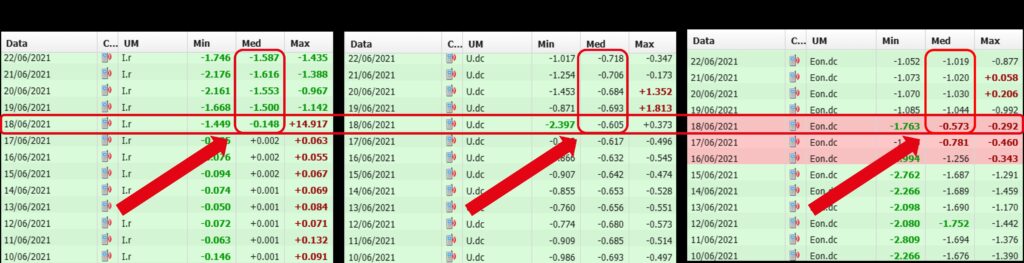
Monitoraggio delle condotte gestione protezione catodica ac dispositivo mitigazione guasto

Therefore, we can identify the day and detect the presence of the fault, also analysing the temporal trend. This is important because if I have to do a historical analysis of the data – not only on this measurement point but on the other points of the system – having a signal that allows me to understand when the alternating current discharge device was not working properly also allows me to correlate the other values.
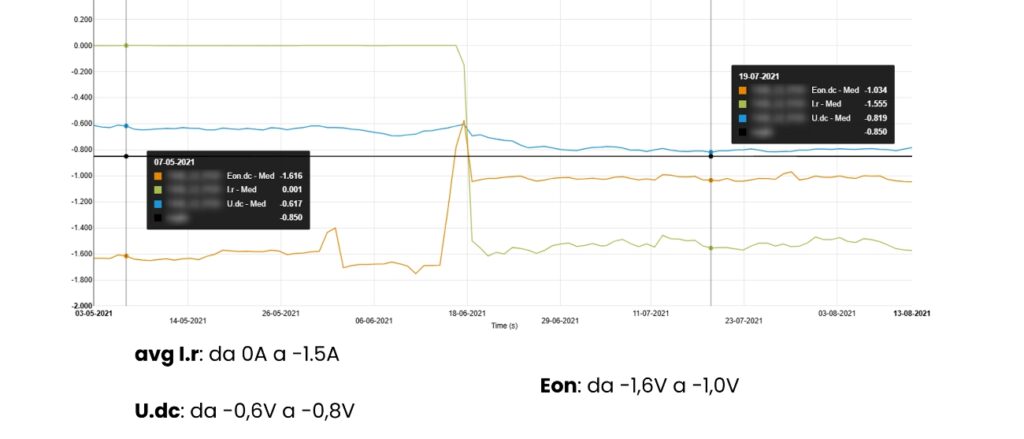
Monitoraggio delle condotte gestione protezione catodica dispositivo mitigazione guasto rilevare

Effective cathodic protection

To ensure that cathodic protection is effective, ISO 15589-1 defines two steps:

  • General assessment
    • ON potential measurements performed on all measurement points or at least on selected ones.
  • Detailed and comprehensive evaluation
    • OFF potential measurements preferably carried out at all measurement points.
    • When an OFF potential measurement on the pipe is not possible, OFF potential measurements are required using probes or coupons at significant time intervals.

The NACE SP0169 standard, which is equivalent to 15589-1, establishes the following criteria:

  • A minimum of 100 mV cathodic polarisation.
  • Structure-electrolyte potential equal to or more negative than -850 mV relative to a copper/copper sulphate saturated electrode (CSE).
    • This potential can be a direct measurement of the polarised potential or an ON potential.
  • Use of cathodic protection coupons to establish current density levels, corrosion potential, polarisation levels.

Evaluation of ON potential

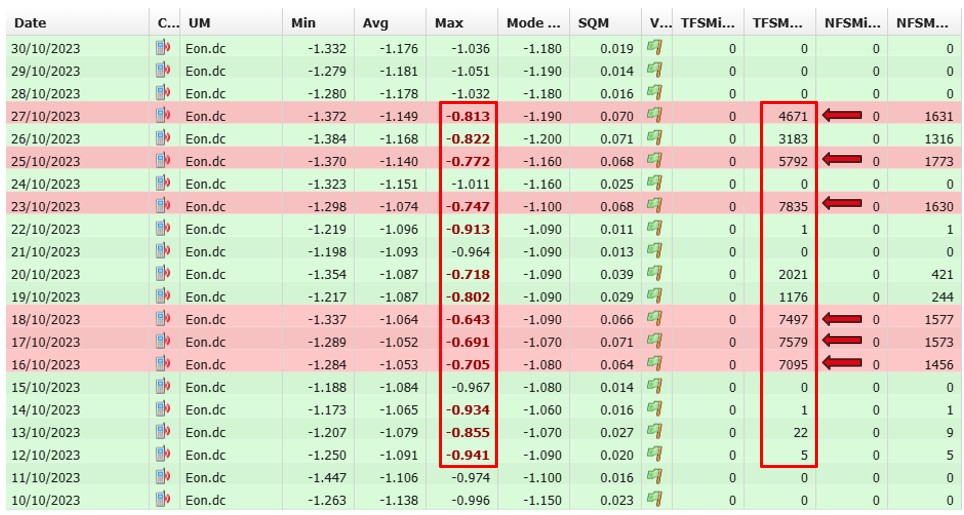
The graph below shows that we are protected during the year. There is, however, a period when the daily maximum is out of protection. This does not mean that we are in a serious risk of corrosion, because we must also evaluate the other information provided by the daily report (e.g. time out of protection).
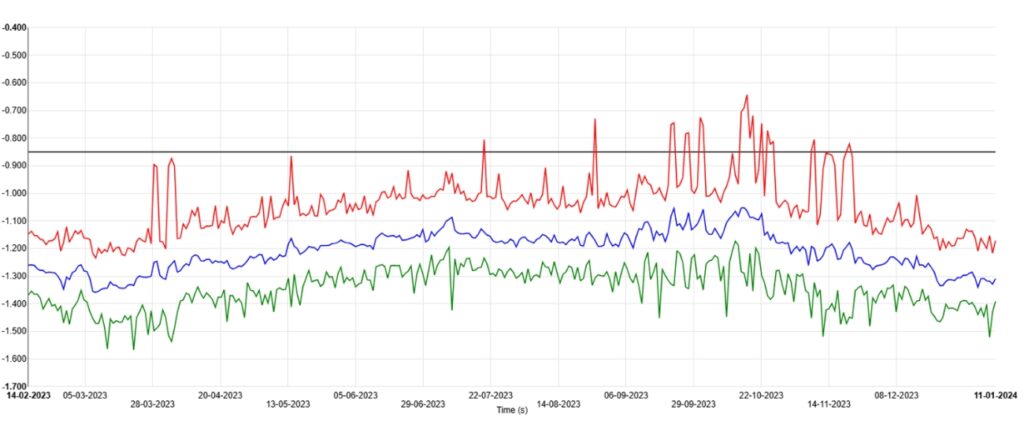
Monitoraggio delle condotte gestione protezione catodica valutazione potenziale on
Monitoraggio delle condotte gestione protezione catodica valutazione potenziale on tabella

Instant-off potential on coupon

Measurement Technique

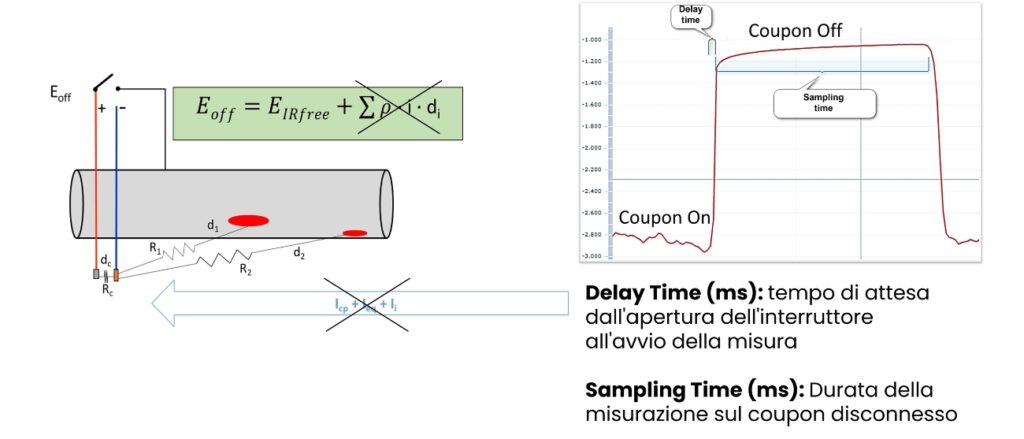
We perform the instant-off measurement with the coupon and manage to eliminate the IR drop. This is a measurement that we can do simply by taking the instant-off values: it is done over a few milliseconds and we can repeat it once per second. Therefore, we have a 1-1 ratio between instant-off potential on coupons and ON potential.
Monitoraggio delle condotte gestione protezione catodica valutazione potenziale instant off

Daily report

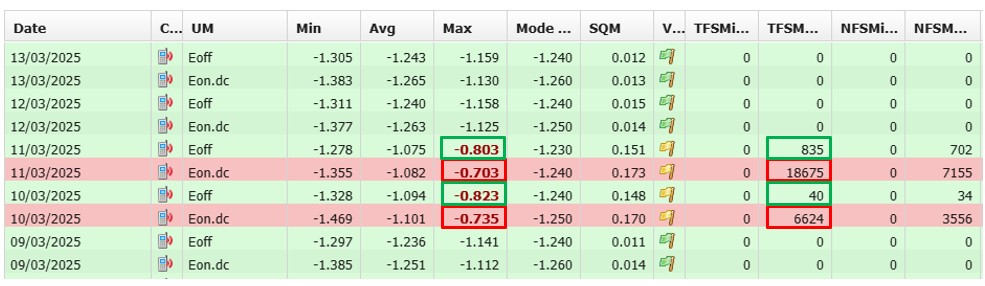
In the report below we see the measurement points, the out-of-protection maximums, and the out-of-protection times. In this case, the time out of protection of the ON potential is between two and five hours. So I might be induced to go into the field to find out what is going on.
Monitoraggio delle condotte gestione protezione catodica valutazione potenziale instant off tabella

As I mentioned earlier, here we are assessing whether we are cathodic or not;we are unable to know what the IR-free potential is to compare with the criterion we apply. Coupons help us: if we take into consideration those same days and the instant-off measure on the coupon where we eliminated the IR, we see that the real time out of protection is negligible.

In a set of measurements where I may have several points where the ON potential is unprotected, the coupon measurement allows me to filter out all those points where there is actually only an ohmic drop in the ground and analyse where there is a real need.

100 mV shift

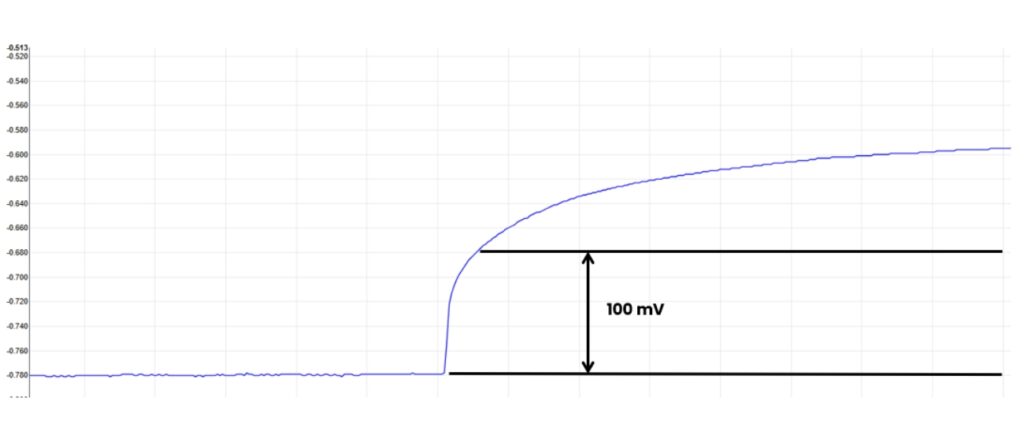
Having the coupon and being able to control it remotely, we can also evaluate the 100 mV shift criterion: I can download the measurement second by second and make the evaluation.
Monitoraggio delle condotte gestione protezione catodica 100 mV shift

DC interference

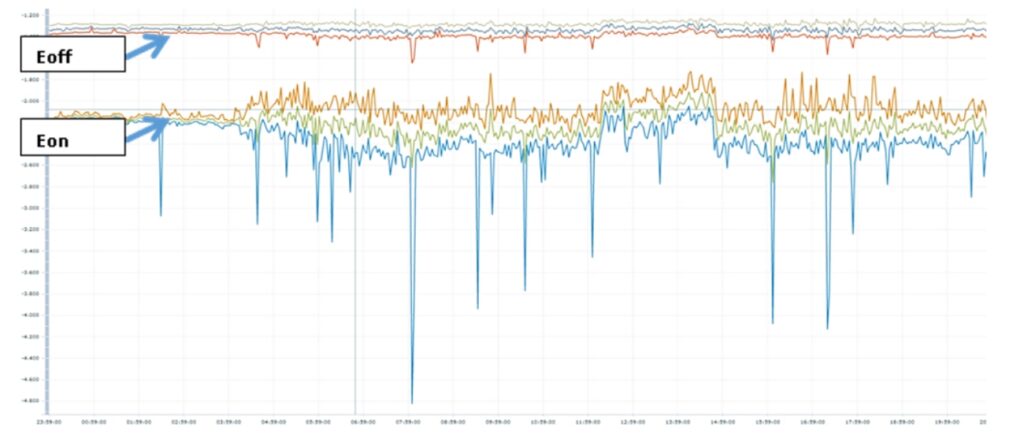
The graph below is interesting because we have the 24-hour ON potential and the instant-off potential on coupon. Having both measures allows us to assess the effect of interference. Looking at the night phase, the two lines are practically parallel. During the passage of trains, however, the ON potential chases all the currents circulating in the ground – these currents do not necessarily enter our structure. Therefore, the possibility of evaluating the two curves in parallel allows us to understand when the interference generates currents only towards the ground and when it also generates them towards the structure, resulting in cathodic and anodic conditions.
Monitoraggio delle condotte gestione protezione catodica interferenza dc

ON potential vs. instant-off on coupon

In the image below we report an example that is very interesting. In an interference condition, I download the measurement second by second. We have 30 seconds of measurement in which there are the ON potential and the current in the coupon. The current in the coupon when cathodic is positive and when anodic is negative. Thus, here we have the effect of an anodic interference that lasts approximately 15 seconds, with a maximum peak of 4 A/m2. Therefore, we have: anodic interference, 4 A/m2 current density, and positive ON potential (+ 0,65V CSE).

The first action one is tempted to take to eliminate a positive potential is to increase the current. However, in this case, by analysing the average daily values, we are heavily overprotected (-1.3 V CSE), so going to increase the current would make the situation even worse.

This is where the point we were making earlier comes into play: the importance of being able to assess the time out of protection. This is because if over the course of 24 hours the structure is protected, 30 seconds of anodic interference is not enough to generate a risk of corrosion. If we were instead to evaluate the instant-off potential during this interference, the most positive maximum value we would reach is -1.1 V. Therefore, it would be harmful to increase the current. If the rest of the cathodic protection system allowed it, we could even consider reducing the current slightly and attempting to exit the overprotection condition.

Therefore, depending on the quality and type of information I receive, I may even be led to make completely opposite choices, but at the risk of making the wrong ones. The more information I can obtain, the more convinced I will be of my actions because they are supported by data –reducing the probability of error.
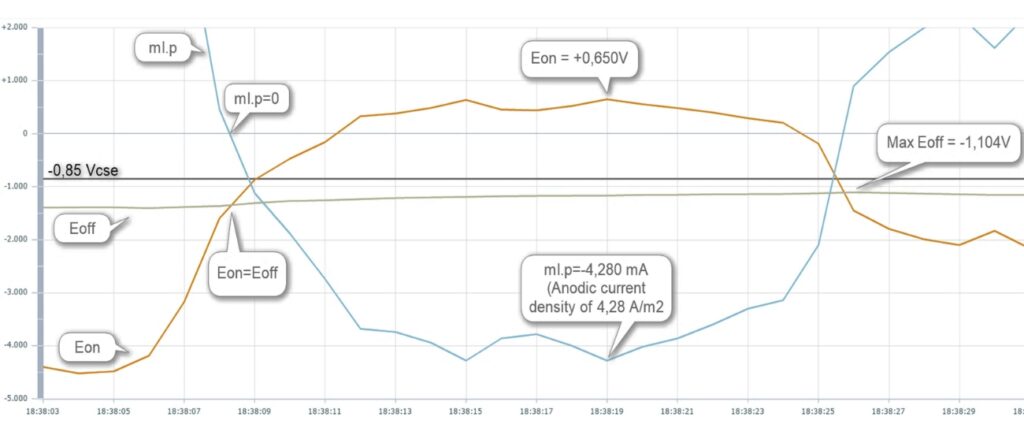
Monitoraggio delle condotte gestione protezione catodica Potenziale ON vs instant off su coupon

AC interference

Alternating interference is rather insidious, as it is highly dependent on ground conditions. Soil conditions can vary throughout the year: a compliant measurement at a certain time of the year does not guarantee – unless I have continuous monitoring – that it will be equally compliant at another time of year.

If, in this case, the technician were to take a measurement, he would find 1.5 V of AC voltage. However, the graph below shows that there are times of the year when even 15 V is exceeded. With continuous monitoring I can get this information.
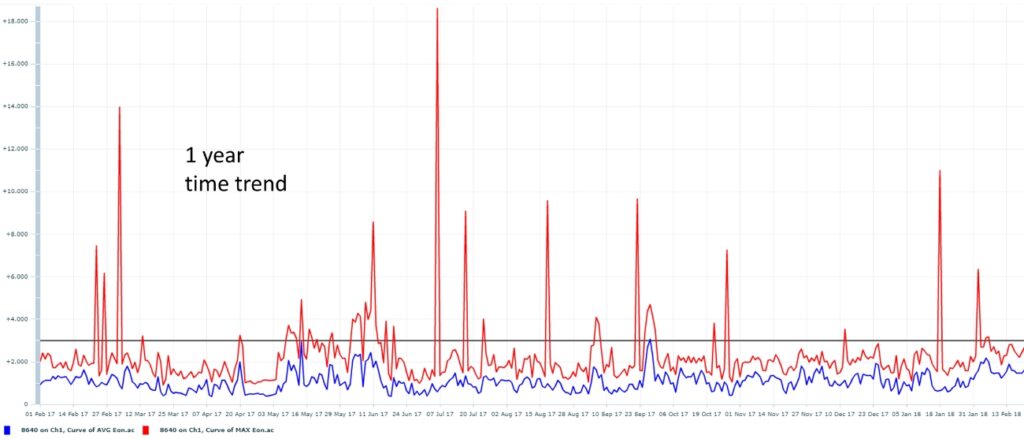
Monitoraggio delle condotte gestione protezione catodica Interferenza AC

The graph below shows what can happen in industrial areas. Shown below is a 24-hour intensive measurement in an industrial area where there is probably a company with machinery with poor ground insulation. Therefore, we can count the machine cycles they are performing within 24 hours, and this may help us identify the source and request a solution to the problem.
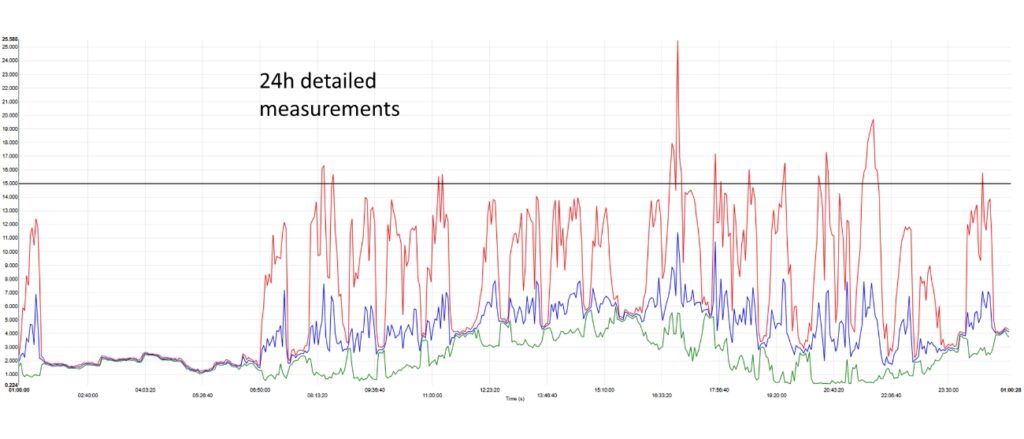
Monitoraggio delle condotte gestione protezione catodica Interferenza AC aree industriali

The AC density is very sensitive to changes in ground resistivity.  So – given the same external conditions – I can have periods of the year when the density is above 30 A/m2, others when perhaps, with a higher resistivity (summer period), the density drops dramatically and then goes back up again.
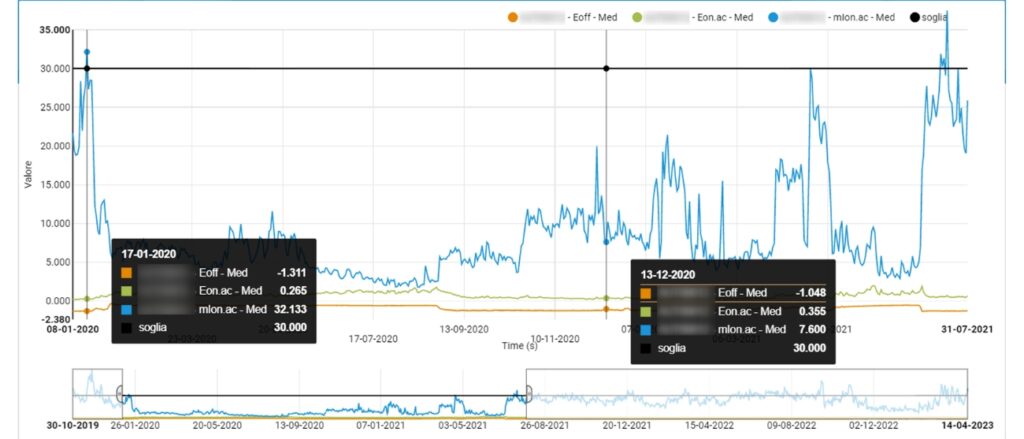
Monitoraggio delle condotte gestione protezione catodica densita di corrente alternata resistivita

The monitoring configuration in the presence of alternating interference becomes quite critical. What we can measure is:

  • DC ON potential on structure and AC voltage;
  • Instant off potential on DC coupon
    (10 cm2 or other size, for evaluation of the protection criterion)
  • DC coupon current density
  • DC and AC current density on AC coupon (1 cm2)

With this setup I can check the following criteria:

  • -1.2V CSE < Instant off potential on coupon < -0.850V
    (according to ISO 15589-1 and SP0169)
  • Average daily AC voltage < 15 Vac (according to ISO 18086 and SP0177)
  • Daily average of Jac < 30 A/m2
    (or Jac < 100 A/m2 if daily average Jdc < 1 A/m2)
    (according to ISO 18086 and SP21424)

In this article and in the previous one we have seen something that for Italy it has been history for 25 years. The ability to integrate remote monitoring features with high-frequency measurement monitoring, typical of data loggers, allows – in the presence of local intelligence capable of processing such data – intelligent reporting, evaluation, and simple detection of conditions that are normally difficult to detect.

The technician does not disappear in this activity, but he stops being a driver: he can spend more time in the office, analysing concrete data and dealing with abnormal conditions – having consistent data.
At a time when human resources tend to be increasingly scarce in various cathodic protection groups, this type of assistance becomes essential for optimising all our activities.

Like Marty McFly in 1955,the rest of the world is finally reaching a future that for us has already been present for a quarter of a century. Italian technology has been the DeLorean, bringing innovation where it seemed impossible.

AUTOMA designs and produces innovative, Made in Italy hardware and software solutions for remote monitoring and control in the Oil, Gas and Water sectors.

We were born in 1987 in Italy, and today over 50,000 Automa devices are installed in more than 40 countries around the world.

Do you want to know the benefits for the security of your networks that you could have with the AUTOMA monitoring system for cathodic protection?

Contact our team without obligation and we will tell you what we can do to optimise your infrastructure control.


By Ivano Magnifico, Product Manager AUTOMA
From the presentation “Back to the future: when the past is already the future”
SMART GRID DAYS 2025, 8 – 9 October 2025.

Are we using the data we receive from the monitoring systems of cathodic protection as we should? To understand this, let’s summarise the history, the current situation and the future of pipeline monitoring, particularly focusing on what we take for granted and what seems normal because we see it every day.

In this article and the next, we will talk about the monitoring methods and how it is possible to optimise data transmission.

With this content, we are mainly addressing foreign readers, who have different management practices than those we have in Italy. However, in any case, the recap can also be useful for us Italians to see if we are working to the best of our abilities.

Definition of Remote Monitoring

UNI EN ISO 15589-1:2017 proposes this definition of remote monitoring: “At a minimum, remote monitoring must provide the same level of information obtained by cathodic protection operators in the field”.

What does this mean? The “minimum” is a precise measurement taken at the same frequency with which a technician can go out into the field to carry out checks. Relying solely on this standard means taking things a bit too literally: you can imagine what it means to take a precise measurement every six months, considering everything that can happen in the meantime.

There is no definition of remote monitoring in the NACE standards. However, there is a working group that has the task of drafting the MR21551 standard on remote monitoring. When this standard is drafted, you will find that there is some reference to what we do in Italy.

RMU vs Datalogger

When we limit ourselves to what the standard requires, we are faced with a contrast between what a remote monitoring unit (RMU) does, which takes measurements from time to time, and what a data logger does, which analyses the effects of interferences with high-frequency measurements. Normally, one faces a dilemma: which one to choose?

If we choose a remote monitoring unit, we limit ourselves toperiodic measurements withlow transmission requirements, but we forego high-frequency sampling. If we choose adata logger, we will have high sampling frequencies and an assessment of transienteffects, but data retrieval will be difficult and usually done manually, as the device does not have remote access.

ON potential trend on structure

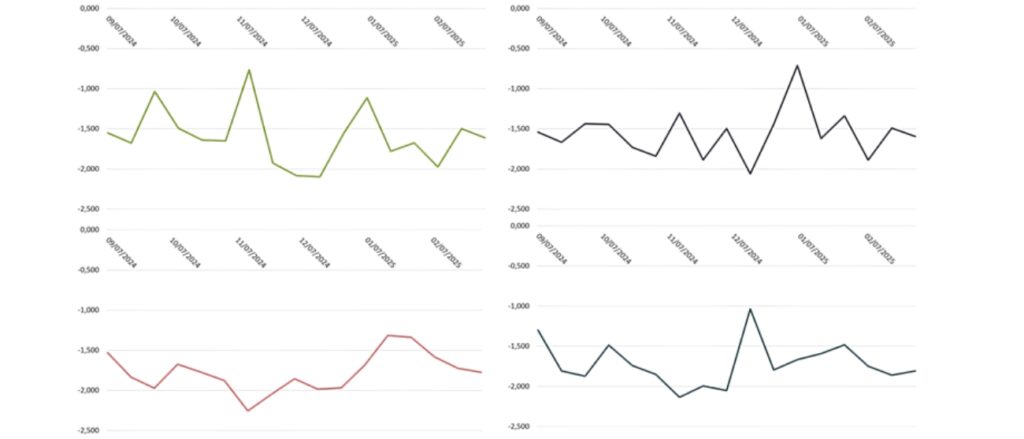
This graph shows four potential trends at four measurement points over six months (one measurement per week).

Monitoraggio delle condotte grafico andamenti potenziale punti misura

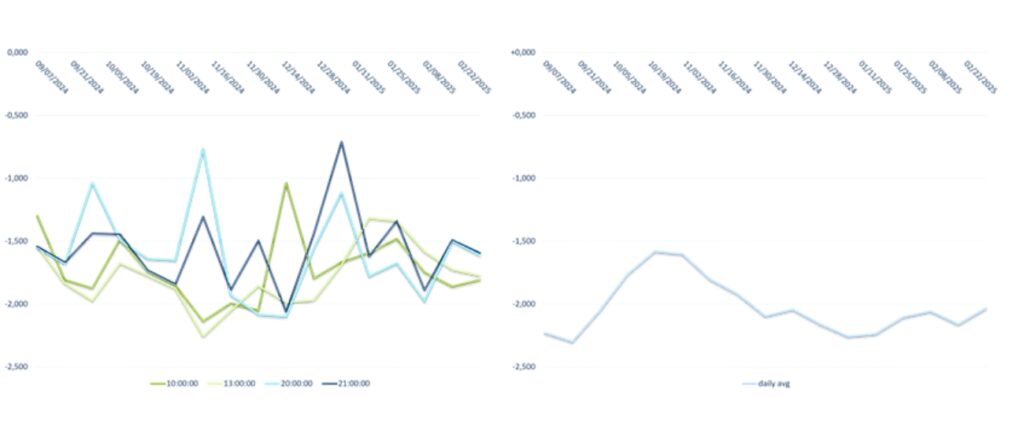
These measurements appear to belong to different cathodic protection systems, but in reality these curves derive from the exact same measurement point but relate to different times: we have the curve for 10:00, 13:00, 20:00 and 21:00 (in the figure below on the left). Therefore, this is what I get when I make a precise measurement with a certain periodicity. I lose track of everything that happens in the meantime: I cannot get clear information on the actual trend, which is what can be seen in the graph on the right.

Monitoraggio delle condotte grafico andamenti potenziale

Remote Data Logger Unit and Edge Computing

To overcome this problem, we need a tool that combines the features of a Remote Monitoring Unit (RMU) and a data logger: a Remote Data Logger Unit. This is a device that not only allows us to combine remote communication with high-frequency monitoring, but is also intelligent, highlighting only the key aspects of the information (indeed, there are constraints in terms of the amount of data that can be sent). The goal is to optimise transmission.

This goal can be achieved through edge computing: a computing model that processes information locally and sends only essential data to the Cloud (daily report). It is therefore a device that, like a data logger, can take one measurement per second at the site where it is placed. With this measurement frequency, at the end of the day, 86,400 measurements will be obtained: being a very high quantity, it is unthinkable to send them all, especially since the device runs on battery.

Therefore, the device processes this information and provides a summary, indicating:

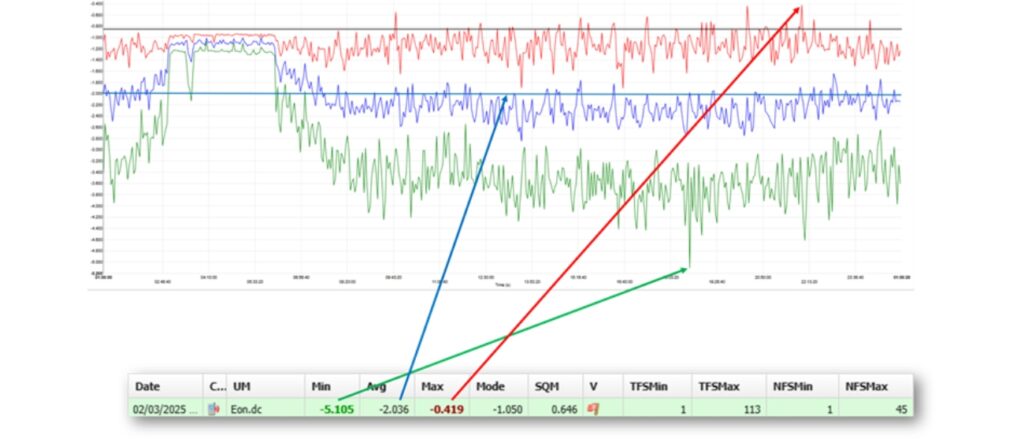
  • Daily minimum, average, maximum: where the average value is a consistent value derived from one measurement per second over the course of the day, making it possible to understand the actual trend (not as in the previous graph on the left).
  • Statistical information: trend, i.e. the most frequent value measured within the 86,400 samples; standard deviation; and variability, to get an idea of how much the measurement varies throughout the day.
  • Total time (seconds) below the minimum threshold and above the maximum threshold during the day: to have a range in which to consider the signal valid or invalid; in the latter case, there will be a series of alarms or conditions to pay attention to.
  • Total number of exceedances of the minimum threshold during the day.
  • Total number of exceedances of the maximum threshold during the day.

    All this information, which is summarised in sets of numbers (see figure below), is contained in few kilobytes of data per day but tells the story of everything that happened over the 24 hours, and it will do so as long as the device is installed.

    Monitoraggio delle condotte tabella remote datalogger unit

    Read the daily report

    Edge Computing

    In the figure, we see in detail some values.

    Monitoraggio delle condotte report giornaliero Edge Computing

    Min, avg, max

    How can we transform the recording of 24 hours of data into a daily report?

    First of all, we have the following information:

    • Minimum value: the most negative value measured over 24 hours;
    • Average value: given by the arithmetic mean of the samples taken over 24 hours;
    • Maximum value: the most positive value measured over 24 hours.
    Monitoraggio delle condotte Min avg max

    Moda

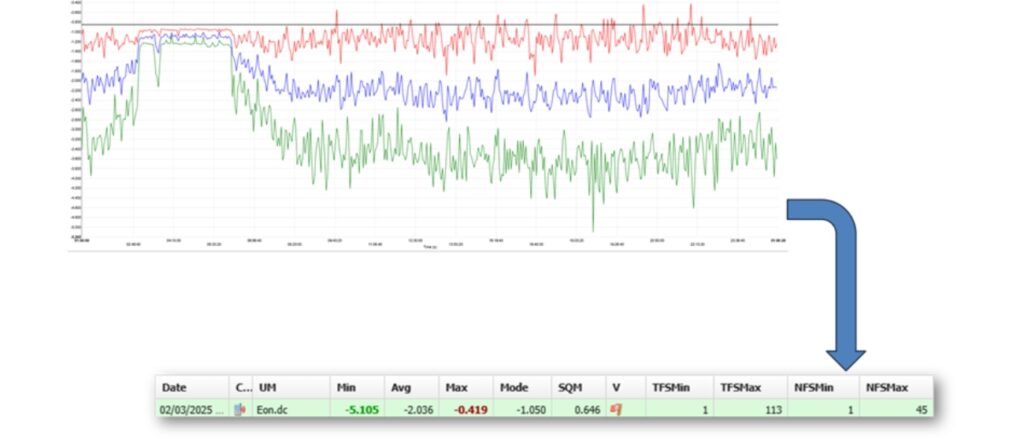
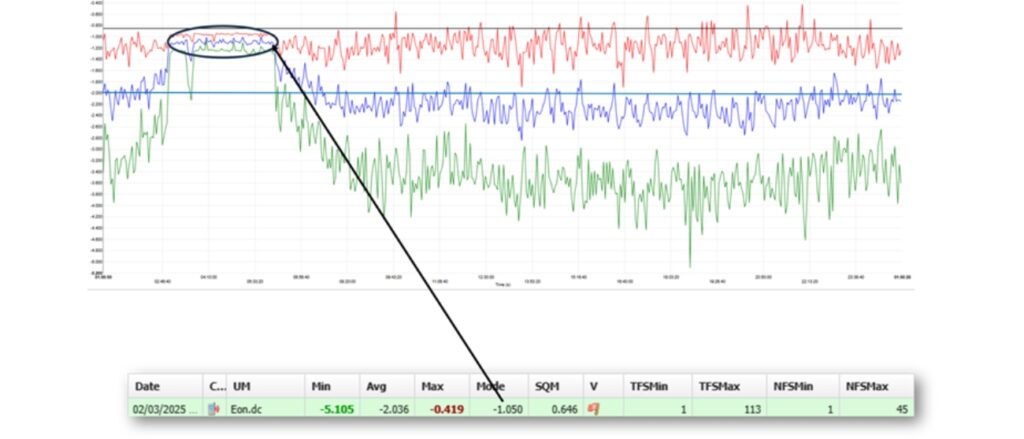
    Arithmetically, trend is the most frequent value within a set of samples (86,400 seconds). Usually, mean and trend have similar values, but when we are faced with a non-stationary interference, such as at a railway crossing (see fig. below), the trend takes on a very particular meaning: during the night hours, we find a slightly more stable measurement range and, almost always, the trend value coincides exactly with the value during the night when the system is not interfered with. Indeed, it is more likely that a value will appear consistently multiple times within that range.

    So, even in a condition where there is considerable variability, it is possible, from these few numbers, also extract information about what the potential is – in the absence of interference – relative to that measurement point.

    Monitoraggio delle condotte moda

    Standard deviation and variability

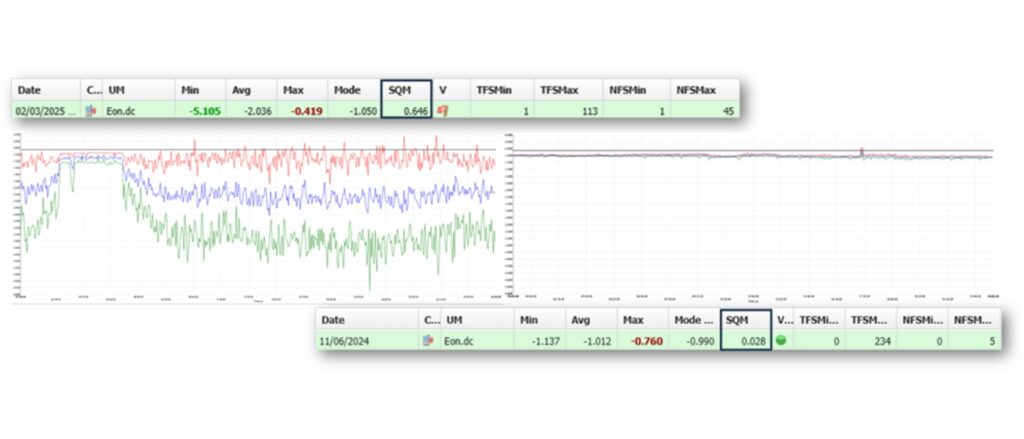
    Looking at the type of graph in the figure below on the left, we would expect the standard deviation (or Mean Square Deviation, MSD) to be quite high. I could have measurements with similar minimum and maximum values, but perhaps due to a single interference that lasted only a few seconds.

    This can be seen from the standard deviation value; indeed, this value indicates how stable my sample population was over the course of 24 hours. Therefore, even if I have rather wide minimum and maximum values as a range, if I realise that I have a low standard deviation (below 0.05), I know that in reality, throughout most of the day, my value has been close to the average value.

    Monitoraggio delle condotte deviazione

    Time and number of alarms

    The daily report also allows us to know how long we have been outside the limit conditions we have set.

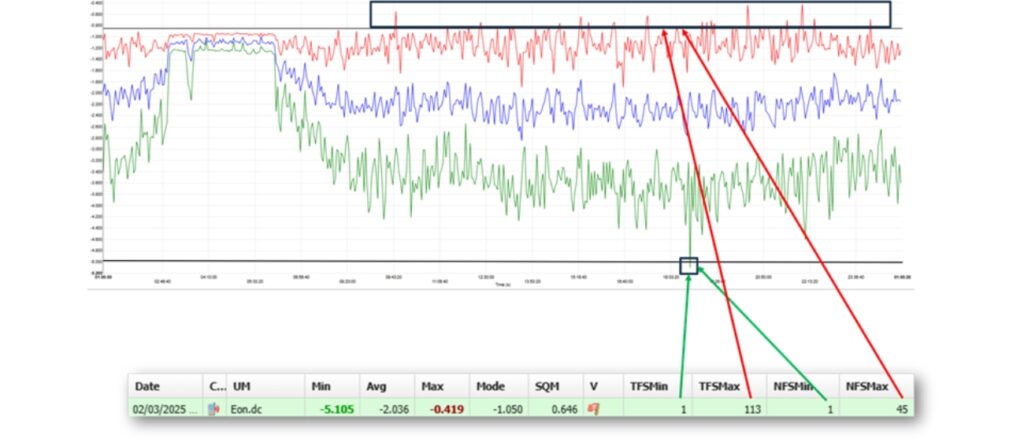
    The minimum out-of-threshold time and the minimum out-of-threshold number provide an overview of how many times you went below that value: in the case shown in the image below, the minimum out-of-threshold was reached once for 1 second. On the other hand, the maximum out-of-threshold time and the maximum out-of-threshold number show how many times one wentabove that value: in the case below, a total maximum out-of-threshold time of less than 2 minutes was reached in forty-five intervals. This, by the way, gives us an idea of the average time out of protection; in this case, we are around 2.5 seconds.

    Why is it crucial? Because by takingcontinuous measurements, I canfind out everything that is happening, and I only need to look at this value to check whether the structure is at risk of corrosion. It is clear that in a condition of continuous cathodic protection, small intervals outside the protection levels do not entail an immediate risk of corrosion: it is up to the technician to decide and set the interval above which it is necessary to be alerted. In any case, in Italy, the regulation has established a maximum value of 3,600 non-continuous seconds.

    Monitoraggio delle condotte Tempo e numero di allarmi

    According to ChatGPT, the term “Edge Computing” started to be known from 2014, but became commonly used around 2017. It is important to note this for a simple reason: everything we have seen so far is what has been done in Italy since 2001 as required by the UNI 10950 standard published that year.

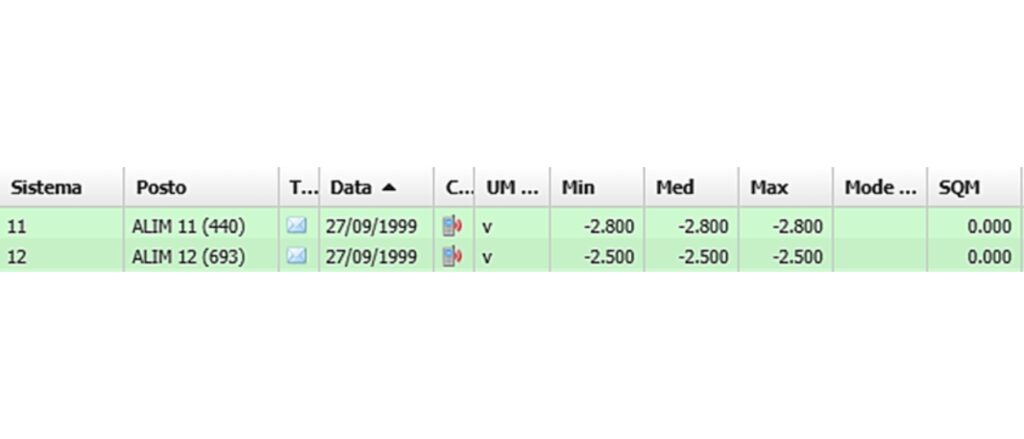
    In the chart below is the first daily report found in our database, which dates back to 1999, proving that we have been doing Edge Computing “without knowing it” for more than 25 years.

    Monitoraggio delle condotte primo report

    AUTOMA designs and produces innovative, Made in Italy hardware and software solutions for remote monitoring and control in the Oil, Gas and Water sectors.

    We were born in 1987 in Italy, and today over 50,000 Automa devices are installed in more than 40 countries around the world.

    Do you want to know the benefits for the security of your networks that you could have with the AUTOMA monitoring system for cathodic protection?

    Contact our team without obligation and we will tell you what we can do to optimise your infrastructure control.

    Maintaining the integrity of gas, oil and water pipelines is in many ways a challenge. When infrastructure is located in remote areas that are difficult to reach, or urban but particularly congested, only a remote monitoring system can make realistic assessments of its health and intervene promptly when needed.

    And if the area where the pipelines are located is affected by stray currents, the challenge becomes even more complex, making it essential to have an efficient remote monitoring system for cathodic protection.

    However, the right remote cathodic protection monitoring system can allow you to work more accurately. Here are its benefits.

    1) You can take measurements every second

    A high-performance remote monitoring system gives the possibility to carry out an extremely detailed survey of cathodic protection: it makes it possible to obtain measurements every second throughout the day, every day.

    This provides information that manual measurements in the field could not capture.

    2) You can accurately identify the anomaly that occurred

    The analysis of the data collected by the monitoring system allows you to trace the ‘problem’ that affected the infrastructure.

    For example, the measurements obtained may suggest that the cathodic protection rectifier is not active or that the impressed current anode resistance is increased, or even that there has been damage to unidirectional drainage, which is unable to interrupt the flow of drained current when it reverses its direction.

    Once the anomaly has been identified, taking action to resolve it is much easier and faster: you can program the intervention times and also, if necessary, evaluate how to reschedule periodic maintenance.

    3) You can overcome the problems arising from stray currents

    In areas with time-varying interfering currents, measurements taken on site for a short period (from a few minutes to a few hours) may have difficulty in grasping ‘out of protection’ conditions.

    Remote monitoring, on the other hand, through a daily measurement per second during the 24 hours, offers a real possibility to correctly assess the effects of interfering currents.

    In addition, in areas affected by stray currents, monitoring several signals at a time (On DC and AC potential, IR-free potential) becomes critical to check compliance with the thresholds indicated by the standards and to check the efficiency of all devices installed so as to reduce the effects of interference (DC and AC decouplers, drainage, etc.).

    To measure the IR-free potential, for example, the Eoff can be measured on a coupon. To bring the IR component to zero and thus consider the Eoff a correct approximation of the IR-free potential, the coupon must be chosen with appropriate shape, size, type and material and installed correctly with respect to the reference electrode and pipe. The best choice for correctly measuring is a device with an integrated solid state switch to manage the connection between the pipe and the coupon.

    Having a remote monitoring technology of cathodic protection allows you to view different data in detail, analyse daily measurements automatically and create alarms for anomalies. The more advanced the technology, the more complete the data it provides and the more it will be possible to optimise cathodic protection system management activities, limiting on-site inspections to only those that are really necessary.

    For example, Automa devices record 86,400 data samples for each channel every day (1 measurement per second). Then they send the WebProCat software a daily statistical report and if a problem emerges from the daily report, a complete data log can be requested from the software to identify its source (e.g. AC interference, stray currents, telluric currents, rectifier failures, etc.).

    The WebProCat software by Automa is specifically designed for cathodic protection analysis, such as battery-powered remote monitoring devices with ultra-low power technologies, which guarantee a minimum of 48 months of uninterrupted operation in the field.

    Our company is today a leader in the design and production of innovative and Made in Italy hardware and software solutions for remote monitoring and control in the Oil, Gas and Water sectors.

    Currently, over 50,000 Automa devices are installed in more than 40 countries.

    Do you want to know what security benefits your networks could have with Automa monitoring system of cathodic protection?

    Contact our team without obligation and we will tell you how we can optimise control of your infrastructure.

    What are the variables to take into account when assessing the efficiency of a network cathodic protection system? There are certainly different types and they are all important. But it is equally important to ensure effective monitoring of the system, otherwise any malfunctions may not be communicated in time to be resolved without problems.

    There are three elements that are essential to pay attention to if you want to be sure that you have a remote cathodic protection monitoring and control system that allows you to accurately assess the health of the pipeline and protect it effectively.

    1) Flexibility

    Full adaptability to different situations and needs is an essential requirement for evaluating the efficiency of a cathodic protection monitoring system.

    The connectivity options offered must be comprehensive: an efficient system must support not only mobile communication, but also wired communication and satellite communication to operate even in areas with poor coverage, and must guarantee access to data and their management in total safety, as well as with maximum simplicity and speed. Integration with pre-existing information systems, such as ERP or GIS, is also essential to maintain smooth communication.

    The best monitoring devices also offer additional channels to measure corrosion rates using standard ER probes, providing complete corrosion monitoring capabilities. And the most high-performance cathodic protection monitoring solutions can be equipped with various accessories such as synchronised ON-OFF switches, solar boxes and interfaces for remote control of rectifiers, which further enhance the system’s capabilities and flexibility.

    2) Maintenance

    A latest-generation cathodic protection monitoring system also allows for more efficient and timely maintenance.

    An example of innovative technology in this sense is the Digital Twin, a digital representation of the structure to be protected: thanks to this virtual and real-time updated reproduction of the physical infrastructure, it is possible to carry out continuous monitoring and simulation of the pipeline performance, structural integrity and operating parameters.

    By integrating remote monitoring data, weather forecasts and other relevant information, you can gain insights into potential issues that threaten your facility, enabling predictive maintenance and operational optimisation.

    Improved analysis of collected data allows you to identify deviations from expected patterns, flagging error conditions before they become critical.

    Additionally, continuously collecting data and using it to train algorithms enables early recognition of anomalies or potential problems. This allows you to plan maintenance activities more effectively.

    This translates into important benefits, such as:

    • minimising downtime
    • optimising the allocation of maintenance resources
    • improving the overall safety and reliability of the monitored facility

    3) Power supply

    One of the greatest challenges in cathodic protection is to maintain the monitoring system in a continuously efficient condition. This translates not only into the need to not interrupt the collection and transmission of data in order to receive any alarm signals in real time, but also into the need to guarantee optimal data collection performance even in the event of an external power failure.

    There are solutions that allow the operation of devices in the field to continue even in the event of a power failure, ensuring uninterrupted operation in the field in the absence of electrical power. This is what Automa’s G4C-PRO ensures, a remote cathodic protection monitoring device with ultra-low consumption technology that guarantees a minimum of 48 months of uninterrupted operation in the field with the integrated battery pack.

    Furthermore, from a resource optimisation perspective, a notable benefit for the effectiveness of cathodic protection also comes from the use of Edge-computing, that is, the ability of devices to locally process information collected from the field to guarantee a first level of local intelligence that allows autonomous actions to be carried out even in the temporary absence of the remote communication channel.

    In this way, it is possible to optimise data sending and ensure that the device transmits only the significant information, with an impact on the amount of energy used for communication.

    Automa solutions for remote monitoring of cathodic protection are based on innovative ultra-low consumption technologies to ensure continuous and efficient communication. Our internal battery powered devices ensure a minimum battery life of four years even in adverse communication conditions. While under optimal signal conditions the lithium battery life of our G4C-PRO can easily reach five years.

    Additionally, the G4C-PRO can also be powered by a small solar panel integrated with backup battery, with 10-12 year replacement time.

    At Automa we develop hardware and software solutions for monitoring and remote control of pipeline integrity, in particular for the cathodic protection and the operational management of networks in the Oil, Gas and Water sectors. Our company was founded in 1987 in Italy, and today over 50,000 Automa devices made in Italy are installed in more than 40 countries worldwide.

    Do you want to be sure that your monitoring system provides truly effective cathodic protection and monitors the integrity of your pipelines with maximum efficiency?

    Contact our team without obligation and we will tell you how you can maintain maximum control over your structures!

    Ensuring the integrity of pipelines (and thus their safety) has a price, like any job. But is it possible to contain operating costs and at the same time ensure extremely efficient monitoring of infrastructure and pipelines?

    Fortunately, the answer is yes. Provided, however, that you equip yourself with high-performance technologies specifically designed to control the effectiveness of your cathodic protection system.

    On-site activities or remote monitoring

    Verification of the functionality of cathodic protection installations according to the criteria outlined in ISO 15589-1 traditionally involves the implementation of on-site procedures, which require operators to visit test stations.

    In the case of Water, Oil & Gas transport and distribution infrastructures, test posts may be located in remote areas, which entails a not insignificant set of risks for the personnel in charge of physical inspections: in addition to the possibility of accidents occurring during travel, the possible burnout of operators called upon to make frequent challenging journeys to hard-to-reach locations must also be taken into account. From a technical point of view, unfortunately there is also always the risk that cathodic protection systems fail immediately after the on-site inspection, requiring a new intervention.

    Checks carried out in person by operators have a significant cost, which increases if they have to be repeated several times. And they cannot be carried out on a daily basis.

    On the contrary, the use of remote monitoring devices enables daily checks to be carried out on all cathodic protection installations and real-time alarms to be received promptly in the event of faults, so that on-site interventions can be optimised and their costs reduced.

    More accurate verification of the effectiveness of cathodic protection at a lower cost

    Detailed evaluations of the effectiveness of cathodic protection require potential-off measurements, preferably at all test points. In cases where potential-off measurements on the pipe are not meaningful – such as in areas with stray currents – potential-off measurements can be performed on external test probes or coupons.

    Normally, these assessments are carried out through on-site activities. However, due to the short duration of the measurements (on-site intervention may take from a few tens of minutes to a few hours), technicians may find it difficult to identify potential problems and possible unprotected conditions, particularly in areas with significant stray currents.

    To overcome these problems, a more comprehensive monitoring approach is required.

    Remote monitoring offers a solution by allowing daily measurements with high frequency sampling: data can be acquired at a rate of one measurement per second throughout the day. This continuous monitoring provides ample opportunity to effectively assess the impact of stray currents on structures. In addition, it facilitates the implementation of continuous instant-off measurements on selected coupons and test points, enabling detailed daily evaluations.

    But that’s not all: by using remote monitoring technology and consequently having daily updates on the status of all installations, an optimised approach to maintenance is possible. In fact, thanks to this technology, on-site checks can be carried out every three years, mainly for a visual inspection of the test point.

    Remote monitoring and consumption

    In order for remote monitoring technologies for Water, Oil & Gas transport infrastructures to be able to reduce the need for on-site human intervention to only essential cases, it is obviously necessary that these technologies are reliable and able to maintain constant communication of the data they collect.

    This is why Automa has designed and manufactured G4C-PRO: an innovative cathodic protection remote monitoring device based on ultra-low power technology. It is a compact data logger enclosed in a small housing with very small dimensions to fit the most common test points worldwide. Even in the absence of power, the G4C-PRO ensures a minimum of 30 days of uninterrupted operation in the field thanks to an integrated backup battery with a life of more than 10 years.

    Reducing the operating costs of network’s cathodic protection control systemis possible with Automa’s solutions, which enable accurate, timely and constant remote monitoring of infrastructure.

    Do you want to see for yourself how Automa’s solutions work and how easy they are to use? Ask us for a free demo without obligation!

    We are all well aware of the critical role cathodic protection plays in ensuring a long pipeline life cycle and pipeline integrity, mitigating risks such as structural failure, explosion or environmental contamination due to corrosion.

    Therefore, it is very important to ensure that the cathodic protection system applied to the facilities works effectively and reliably. The fact that these infrastructures are often located in remote areas can complicate monitoring and control operations, unless highly performing systems are in place.

    How can you assess whether you are getting all the information you actually need toensure that your pipelines are working with maximum efficiency?

    Here are some questions you should ask yourself, and the answers you should give yourself in order to work with peace of mind.

    1) Can you check the functionality of your cathodic protection system?

    According to ISO 15589-1, which outlines the criteria for assessing whether the cathodic protection system applied to a facility is functioning properly, you should carry out functionality inspections of all equipment, such as: impressed current stations, one-way drain stations, connections to external facilities (both direct and resistive bonding), AC and DC decoupling devices, galvanic anodes and test stations. For each of these equipment, maximum time intervals between inspections are defined, which differ depending on the device.

    An on-site inspection not only requires frequent and exhausting travel, but also does not protect you from the risk of a device failing immediately after the inspection, forcing you to return to the site. All this can be avoided with remote monitoring, provided, however, that your system is able to give you real-time data on the performance of different equipment, also helping you to manage maintenance more efficiently.

    2) Can you make accurate and precise measurements of ON potential and OFF potential at all measurement points?

    Also according to ISO 15589-1, the verification of the effectiveness of cathodic protection can be carried out at two levels: the general evaluation is mainly based on measurements of the ON potential on all measurement points or only on representative ones, while the detailed evaluation also requires measurements of the OFF potential, preferably on all test posts.

    Due to the short duration of on-site measurements (varying from minutes to hours), however, technicians may find it difficult to identify potential problems and possible unprotected conditions, particularly in areas with significant stray currents. For this reason, measurements can be performed on external test probes or coupons.

    3) Is your measurement system adequate for the effect of high stray currents?

    In the case of high stray currents, the potential analysis Eon may not be sufficient because it provides incomplete or sometimes misleading information.

    Therefore, it becomes necessary to measure the IR-free potential, e.g. by measuring the Eoff on a coupon, which must be of a specific type and made of an appropriate shape, size and material, as well as correctly installed with respect to the reference electrode and the pipe.

    Only under these conditions can the Eoff measure on the coupon bring the IR component to zero and thus Eoff can be considered a correct approximation of the IR-free potential.

    The best choice for coupon measurements is a monitoring device with an integrated solid-state switch to handle remote communication.

    4) Have the measurement points been selected to ensure the best monitoring coverage?

    If the distribution of measurement points has not been made with the specificities of the facility in mind, the monitoring system may not perform as well as it could in detecting faults and verifying the effectiveness of cathodic protection.

    The measurement points selected for monitoring can be of different types:

    • points at the boundaries of the cathodic protection system, e.g. at insulation joints
    • points where the least negative potentials were measured during commissioning
    • critical or representative points of the cathodic protection system
    • points associated with foreign facilities, so that changes can be detected.

    A monitoring system that takes data from inadequate measurement points cannot give you all the information you need to ensure effective cathodic protection of the facility.

    5) What happens to your monitoring system in case of power failure?

    Risking being without data can be very dangerous when it comes to pipelines. Therefore, it is essential that your system transmits alarm signals in real time in the event of an external power supply failure.

    But obviously receiving the warning is not enough. That is why it is essential to equip oneself with devices capable of guaranteeing optimal performance for long periods even in the event of an external power failure, calculating also that reaching them for the eventual replacement of the batteries could take a long time in which the facility would in fact be unmonitored.

    It is therefore better to select a solution with ultra low power consumption technology. Automa’s G4C-PRO, for example, is a remote cathodic protection monitoring device that guarantees a minimum of 30 days of uninterrupted operation in the field, even in the absence of electricity, thanks to an integrated backup battery with a service life of more than 10 years.

    6) How often do you have to replace batteries in the field?

    Today there are high-performance solutions in terms of consumption. At Automa, we are experts in low power consumption technologies, such that our internal battery-powered devices have autonomies of at least four years even in adverse communication conditions. Under optimal signal conditions, the lithium battery life of our G4C-PRO can even extend up to five years without any problems. And G4C-PRO can also be powered by a small integrated solar panel with battery backup, with a replacement time of 10-12 years.

    Founded in 1987 in Italy, over the years our company has established itself as a leader in the design and production of innovative Made in Italy technologies for remote monitoring and control in the Oil, Gas and Water sectors.

    We develop hardware and software solutions for remote monitoring and control of pipeline integrity, in particular for cathodic protection and network operation.

    Currently, more than 50,000 Automa devices are installed in about 40 countries.

    Do you want to know whether your current monitoring system really provides you with effective cathodic protection and efficiently monitors pipeline integrity?

    Contact our team without obligation and we will tell you how you can maintain maximum control over your facilities!